Champagne: The Pinnacle of Sparkling Excellence
The World of Champagne
Champagne is the global benchmark for sparkling wine, defined by its rigorous production standards and centuries of tradition. True Champagne must originate from the chalky soils of the Champagne region in northern France and is produced using the Méthode Champenoise. This process involves a secondary fermentation inside the individual bottle, creating a signature complexity. The result is a sophisticated wine celebrated for its fine, persistent bubbles, high acidity, and a distinctive profile that balances fresh citrus with rich, toasted notes.
The Flavor Profile of Champagne
From Brioche to Citrus
Champagne is renowned for its depth and “yeasty” character, which comes from the wine’s extended time aging on the lees (spent yeast cells).
- Primary Fruits: Crisp lemon, yellow apple, and white peach.
- Secondary Notes: Fresh-baked brioche, toasted almond, and marzipan.
- Finish: A sharp, mineral-driven finish with a creamy mouthfeel created by the delicate mousse (bubbles).
Two Worlds
Non-Vintage vs. Vintage
The region produces different styles based on the harvest year and the producer’s “house style.”
Non-Vintage (NV): A consistent blend of multiple years, designed to represent the producer’s signature flavor every time you open a bottle.
Vintage Champagne: Produced only in exceptional years using grapes from a single harvest. These wines are aged longer, offering greater intensity, power, and nutty complexity.
Food Pairing
The Versatile Gastronomy Wine
High acidity and effervescence make Champagne one of the most versatile wines for a full meal, cutting through rich fats and complementing delicate textures.
- The Perfect Match: Fresh oysters, caviar, and salty appetizers.
- Unexpected Pairings: Fried chicken (the acidity cuts the grease perfectly), truffle popcorn, and triple-cream brie.
- Serving Tip: Serve at 45–50°F (7–10°C). Use a tulip-shaped glass or a wide flute to allow the complex aromas of aged Champagne to develop.
Fun Facts About Champagne
The Pressure: A standard bottle of Champagne contains about 5 to 6 atmospheres of pressure—nearly three times the pressure in a car tire.
The Grapes: Almost all Champagne is made from a blend of three grapes: Chardonnay, Pinot Noir, and Pinot Meunier.
Magnum Magic: Many experts believe Champagne tastes best in a Magnum bottle (1.5L), as the larger volume allows for a slower, more graceful aging process.
Deep Cellars: The region sits atop miles of ancient chalk caves (crayères) where millions of bottles are stored at a perfect, constant temperature.
Champagne Characteristics
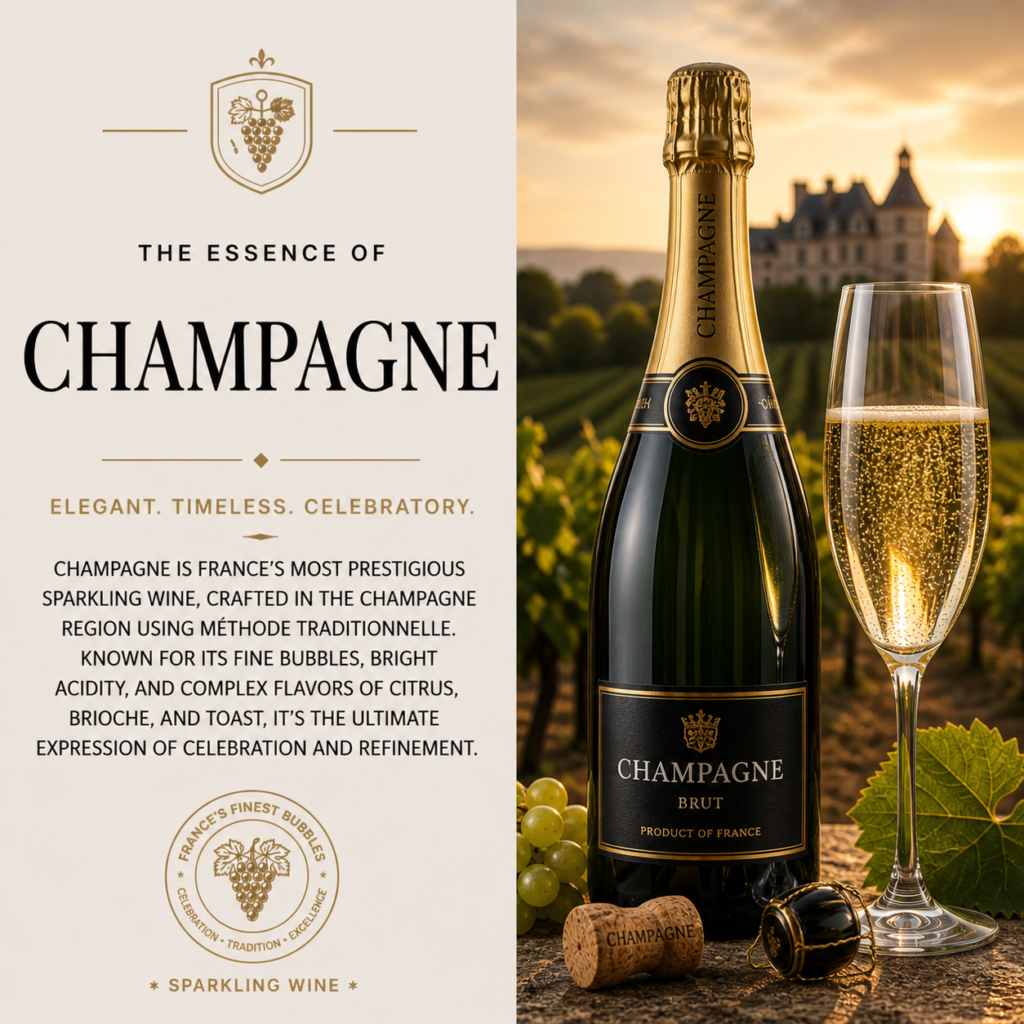
Champagne is the world’s most prestigious sparkling wine, prized for its golden brilliance and its intricate, multi-layered texture. It offers a refined and luxurious profile that has made it the definitive choice for those seeking a balance of bright acidity and savory, toasted complexity.
Medium Body: Substantial on the palate with a silky, creamy mousse.
High Acidity: Sharp and refreshing, providing a structured backbone.
Citrus & Orchard Fruit: Vibrant notes of lemon zest and crisp yellow apple.
Autolytic Notes: Noted for complex hints of brioche, toast, and biscuit.
Bottle-Fermented Precision: Produced via the traditional method for unparalleled bubble fineness.
Champagne is a true reflection of the cool-climate viticulture of northern France, ranging from the bright and zesty Blanc de Blancs to the richer, more structural Blanc de Noirs. This variety in style allows Champagne to be a reliable choice for every stage of a meal, from the first toast to the final course, offering a timeless sense of elegance and celebration.
Prestigious & Structured Style
Toasted & Brioche Profile
Long, Mineral Finish
Exceptional Aging Potential
Fine & Persistent Bubbles
Bright Golden Color
Perfect for Gourmet Pairings
Champagnes
California: The Icons (Napa & Sonoma)
Domaine Carneros – Le Rêve Blanc de Blancs
Roederer Estate – L’Ermitage
Iron Horse Vineyards – Joy!
Mumm Napa – DVX
Domain Chandon – Étoile Tête de Cuvée
J Vineyards & Winery – Cuvée XB
Gloria Ferrer – Royal Cuvée
Breathless Wines – Brut Rose
Under the Wire – Single Vineyard Sparklers
Inman Family Wines – Brut Rosé
Scribe Winery – Petillant Naturel & Traditional Method
Ultramarine – Heintz Vineyard (Cult Favorite)
Cruse Wine Co. – Tradition Sparkling
Carboniste – Modern California Sparklers
Equinox Wines – Santa Cruz Mountains
Rack & Riddle – Custom Crush Icons
Pellegrini-Olivet Lane – Russian River Valley
Frank Family Vineyards – Blanc de Blancs
Laetitia Vineyard – Cuvée M
Oregon & Washington: The Cool-Climate Contenders
The Willamette Valley’s latitude and climate are remarkably similar to Champagne, leading to world-class acidity and structure.
Argyle Winery – Extended Tirage Brut
Gran Moraine – Yamhill-Carlton Brut Rose
Soter Vineyards – Mineral Springs Brut Rose
ROCO Winery – RMS Sparkling
Rollin Soles – The Maestro of Oregon Bubbles
Lundeen Wines – Brut Nature
Division Wine Co. – Crémant de Portland
Analemma Wines – Columbia Gorge
Treveri Cellars – Blanc de Noirs (Washington)
Syncline Winery – Scintillation
New York: The Finger Lakes (Cold-Hardy Elegance)
New York is arguably the most “Champagne-like” in temperature, producing high-acid, mineral-driven wines.
Hermann J. Wiemer – Cuvée Brut
Dr. Konstantin Frank – Blanc de Noirs
Lamoreaux Landing – Brut Rose
Red Newt Cellars – Sparkling Riesling
Ravines Wine Cellars – Brut Argetsinger
Sparkling Pointe – Seduction (Long Island)
Wölffer Estate – Noblesse Oblige
Glenora Wine Cellars – Brut Irondequoit
Hosmer Winery – Finger Lakes Brut
Forge Cellars – Artisanal Bubbles
Emerging Regions: Texas, Virginia, New Mexico & Beyond
Gruet Winery – Gilbert Gruet Grande Reserve (New Mexico)
Heath Sparkling Wines – Euphoria (Texas)
Trump Winery – Reserve Brut (Virginia)
Thibaut-Janisson – Virginia Fizz
Mawby Sparkling – Talismon (Michigan)
Black Star Farms – Beisner Vineyard (Michigan)
Messenger Wine – Texas Bubbles
Veritas Vineyard – Scintilla (Virginia)
Bending Branch Winery – Brut (Texas)
Ste. Chapelle – Special Harvest (Idaho)