
It happens to everyone. You are ready to open a bottle of wine and the corkscrew is nowhere to be found. Before you give up or run to the store, there are several methods that actually work for opening a wine bottle without a corkscrew. Some require common household items. All of them require a little patience.
This guide covers the most reliable methods, what to avoid, and a few things worth knowing about why this situation comes up more often than you might expect.
First — Check the Bottle
Before trying any method, look at the top of the bottle. More wine is sold with screw caps, synthetic corks, and glass stoppers today than ever before. These closures are common across white wines, rosé wines, and many everyday red wines. If your bottle has a screw cap, you do not need any tools at all.
Also check whether the wine has already been opened. If the cork is partially exposed or loose, even a butter knife or similar flat tool might be enough to pull it free.
If the bottle does have a traditional cork, here are your best options.
Method 1 — Push the Cork In
This is the easiest and most reliable method when you have no tools at all. Instead of pulling the cork out, you push it into the bottle.
Use the handle of a wooden spoon, a marker, a thick pen, or any blunt, narrow object that fits into the neck of the bottle. Press firmly and steadily against the center of the cork. Work it down slowly. It takes some force but the cork will eventually push through into the wine.
Once the cork is inside the bottle, the wine is accessible. The downside is that you cannot get the cork back out. This method works best when you plan to finish the bottle that evening. Be aware that small cork fragments may fall into the wine — simply strain or decant through a fine strainer before serving.
Method 2 — Use a Screw and Pliers
This method takes a few minutes but works very well. You need a long screw, a screwdriver, and a pair of pliers or the claw end of a hammer.
Drive the screw into the center of the cork with the screwdriver. Leave about an inch of the screw sticking out above the cork. Then grip the exposed screw firmly with the pliers and pull straight up while holding the bottle steady with your other hand. The screw acts like a corkscrew worm and the cork will come out cleanly.
This is one of the most controlled methods on this list. If you have a toolkit at home, you almost certainly have everything you need.
Method 3 — Use a Knife
A serrated knife works as a makeshift corkscrew if used carefully. Insert the tip of the blade into the cork at a slight angle and work it in a circular motion while applying upward pressure. Essentially you are using the blade like a lever to slowly extract the cork.
This method requires patience and care. Do not force the blade or use excessive pressure. Keep the bottle on a stable surface and make sure your hand is not near the blade. A thick, serrated steak knife works better than a thin paring knife.
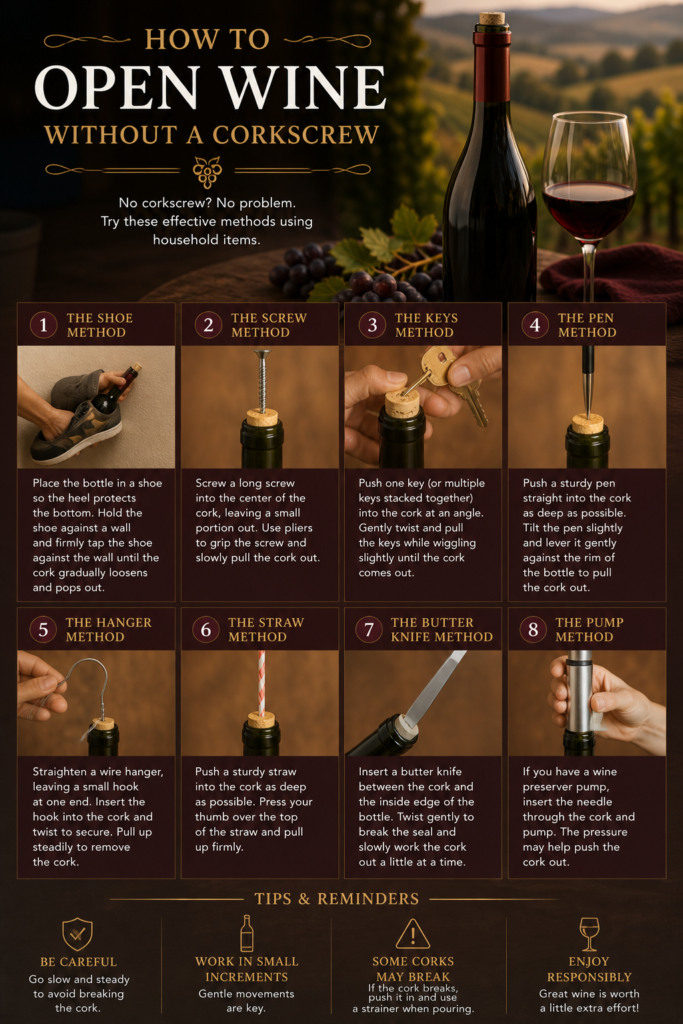
Method 4 — The Shoe Method
This method works, though it requires some effort and confidence. Remove any foil from the neck of the bottle. Place the bottom of the bottle inside a shoe — ideally one with a thick, firm sole like a leather dress shoe or a sneaker. Hold the bottle and shoe together and strike the shoe firmly against a wall or a solid surface repeatedly.
The impact transfers through the shoe to the wine in the bottle. The hydraulic pressure this creates gradually pushes the cork outward. Check the cork after every few strikes. Stop when it has moved out enough to grip with your fingers and pull free.
Do this outdoors or in a low-risk area. The method is legitimate but there is some risk of the bottle breaking if struck too hard or against an uneven surface. Strike with moderate, controlled force — not full strength.
Method 5 — Use Heat
This is a last resort and requires extra care. Apply gentle heat to the neck of the bottle just below the cork using a lighter or a small torch. The idea is that the air between the wine and the cork expands with heat and pushes the cork outward.
Move the heat source back and forth along the neck rather than holding it in one spot. This can take several minutes. Stop as soon as the cork begins to move and allow it to cool slightly before handling.
Never apply heat to a cold bottle that has just come out of the refrigerator. The temperature difference can cause the bottle to crack. This method is not recommended for sparkling wine under any circumstances — pressurized bottles are not safe to heat.
What to Avoid
A few methods that circulate online are genuinely risky and worth skipping.
Hitting the bottom of the bottle against a hard surface without a shoe can cause the bottle to break. The force required is unpredictable and glass injuries are serious.
Using a wire hanger or improvised metal tool to fish out the cork is rarely effective and can push cork debris into the wine.
Trying to remove the cork with your teeth is not a real method and is not safe.
After Opening Without a Corkscrew
If the cork went into the bottle, strain the wine before serving to remove any small fragments. A fine mesh strainer, a coffee filter, or a piece of cheesecloth over the mouth of a decanter or glass pitcher all work well.
If the cork came out intact, store any leftover wine the same way you normally would. Wrap the cork in plastic wrap and push it back into the neck of the bottle. The fit will not be perfect but it will slow oxidation overnight.
Learning to open wine without tools is a useful life skill, but the better long-term solution is simply keeping a corkscrew in more than one place. A waiter-style corkscrew costs a few dollars and fits in a pocket, a purse, or a kitchen drawer without taking up any space.
For everything else you want to know about wine — from how it is made to how to choose the right bottle — start with our wine basics guide. And if you are ready to explore specific styles, browse our full range of wine types to find something new to open tonight.
Frequently Asked Questions
Is it safe to push the cork into the bottle?
Yes. The cork is inert and does not affect the flavor of the wine. Strain the wine if any small fragments break off. Finish the bottle the same day since re-sealing is not possible once the cork is inside.
Will the shoe method break the bottle?
It can if done with too much force against a hard, uneven surface. Strike firmly but in a controlled way. A thick rubber sole shoe and a solid flat wall minimize the risk.
Can I open a screw-cap bottle that is stuck?
Run the cap under warm water for 30 seconds to loosen it. Wrap a rubber band around the cap for extra grip. If it is still stuck, use a damp cloth for traction.
Does it matter what type of cork the bottle has?
Synthetic corks are more resistant to the screw method since they are denser and harder than natural cork. The push-in method works on both types.
What is the easiest tool to improvise as a corkscrew?
A long wood screw and a pair of pliers is the closest to a real corkscrew that most people can put together from household items. It is reliable, controlled, and leaves the cork intact. Check our wine terminology guide if you want to learn more about closures and what they mean for the wine inside.